
Friday, March 13th, 2026
Data is a critical resource for managing mobility and freight flows in increasingly complex urban environments. Yet most mobility data remain fragmented across public authorities, logistics operators and infrastructure managers.
How can data spaces help cities and industry move from isolated datasets to meaningful data sharing?
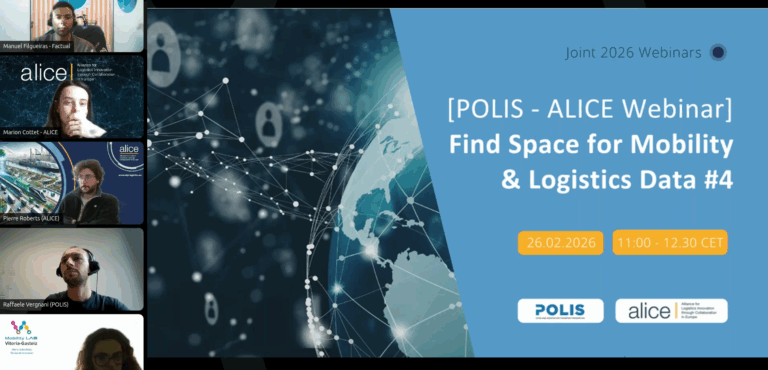
This question framed the first POLIS-ALICE webinar of 2026, which explored how data spaces could enable secure and interoperable data exchange for mobility and logistics systems.
A practical example comes from Vitoria-Gasteiz, where the Mobility LAB initiative is combining real-world experimentation with the development of a regional mobility and logistics data space.
Mobility LAB provides a sandbox environment where companies, research organisations and public authorities can test new mobility solutions under real conditions.
Two projects illustrate how data spaces can support logistics services.
The DataLOG project focuses on intermodal logistics at the Jundiz hub. By enabling data sharing between infrastructure managers, rail operators and logistics companies, the initiative aims to improve operational coordination and support a shift from road to rail freight.
Meanwhile, the DataDUM project addresses urban freight challenges linked to low-emission zones and microhub deployment. Digital services are being tested to improve microhub participation and facilitate freight access and parking management as urban regulations evolve.
Both projects rely on co-creation with logistics stakeholders to ensure that digital services address real operational needs.
While Mobility LAB demonstrates how data spaces can emerge locally, the DeployEMDS project offers a broader European perspective.
Rather than creating a single European database, the future European Mobility Data Space aims to connect existing initiatives through a federated architecture. Shared technical building blocks, a federated data catalogue and governance frameworks will allow stakeholders to exchange data while maintaining control over their assets.
DeployEMDS is currently testing this approach across multiple cities and use cases, tackling persistent challenges such as incompatible standards, legal complexity and limited trust between actors.
Examples include data sharing for EV charging optimisation, interoperable ticketing systems, and urban mobility indicators used for policy monitoring.
The webinar highlighted an important shift: mobility data spaces are moving from concept to experimentation.
Initiatives such as Mobility LAB demonstrate how cities can test concrete services through real-world pilots, while European projects like DeployEMDS are developing the frameworks needed to connect mobility data ecosystems across borders.
However, the discussion also made clear that technology alone will not drive adoption. Experimentation, clear operational value and trusted governance frameworks will be essential to build confidence among stakeholders and turn data-sharing ambitions into practical solutions.
The webinar concluded with the launch of ALICE’s Digital Urban Freight (DUF) community, which aims to support collaboration among practitioners working on the digitalisation of urban freight.
The full workshop report, including detailed figures, policy recommendations, and a complete record of the discussion, is available exclusively to ALICE members via the Knowledge Platform.