
Monday, February 16th, 2026
ALICE and the SEAMLESS project jointly organised an online webinar on the legal status and regulatory framework of automated ships, bringing together around 40 participants from industry, research and public authorities. The session focused on how current maritime and inland waterway regulations are evolving to accommodate autonomous and remotely operated vessels, and what this means for future deployment in Europe.
The webinar was opened and moderated by Tomasz Dowgielewicz (ALICE), who introduced the objectives of the SEAMLESS project and positioned the session within a broader series of technical webinars addressing key building blocks and enablers for automated waterborne transport. He outlined SEAMLESS’ ambition to support the shift from road to waterways through economically viable and environmentally efficient autonomous feeder services.
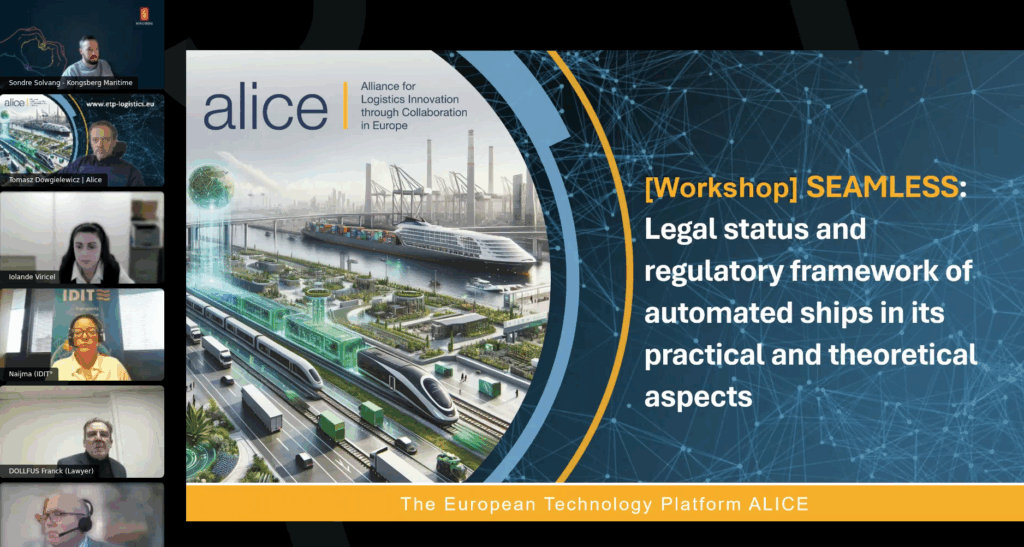
Naijma Djoubri and Iolande Viricel (Institut du Droit International des Transports (IDIT)) presented the legal perspective on automated ships. Their contribution focused on how autonomous vessels are currently qualified under international and national maritime law, and whether they can be considered “ships like any other”. Drawing on SEAMLESS use cases, they highlighted ongoing uncertainties related to seaworthiness, the role of the master, crew requirements and remote operation, as well as the lack of a fully harmonised international framework.
The regulatory developments at international level were then addressed by Jérôme Faivre (Bureau Veritas), who provided an update on the work of the International Maritime Organization (IMO) on Maritime Autonomous Surface Ships (MASS). He explained the status and roadmap of the IMO MASS Code, including key decisions on responsibility, remote operations, risk-based approval and certification. The presentation highlighted the transition from the current non-mandatory phase toward a future mandatory framework expected in the early 2030s.
Sondre Solvanng (Kongsberg Maritime) followed with an industry perspective on how regulatory engagement and risk-based approval processes are applied in practice. He described how Kongsberg Maritime works with flag states and classification societies to support the approval of autonomous and remotely operated vessels, emphasising the role of structured risk assessment, verification and testing. Concrete examples from recent projects illustrated how regulatory frameworks enable real-world deployment.
The inland waterway perspective was presented by Fionn Halleman (Voies navigables de France (VNF)), who outlined the regulatory landscape for automated navigation on European inland waterways. He explained the role of the Central Commission for the Navigation of the Rhine (CCNR) and CESNI in setting standards and approving experimental operations, highlighting differences compared to the maritime approach and the challenges of cross-border operations. The presentation underlined that inland automation is progressing through experimentation, with remotely operated vessels currently leading developments.
The webinar concluded with an open discussion on regulatory fragmentation, the transition from pilots to commercial operations, and the need for greater coherence across European frameworks. Participants agreed that while technology is advancing rapidly, regulatory clarity and alignment remain critical enablers for the deployment of automated vessels in both maritime and inland navigation.
The SEAMLESS webinar confirmed the importance of continued dialogue between regulators, industry and research to support safe, scalable and interoperable autonomous waterborne transport solutions in Europe.
The full workshop report, including detailed figures, policy recommendations, and a complete record of the discussion, is available exclusively to ALICE members via the Knowledge Platform.