
Monday, December 29th, 2025
The European Commission has released a new fact-finding study evaluating the maturity, potential, and policy needs of the emerging European hyperloop sector. The analysis confirms that hyperloop technology – long considered a visionary mobility concept – is rapidly progressing from design and prototyping toward early demonstration, with several European developers now among the global leaders in the field.
Hyperloop promises ultra-high-speed, low-emission mobility for passengers and freight, potentially transforming long-distance travel, reshaping supply chains, and strengthening Europe’s internal connectivity. The new study, published by the Directorate-General for Mobility and Transport, provides the first EU-wide assessment of the sector’s technological readiness, regulatory environment, business prospects, and possible paths for European support.
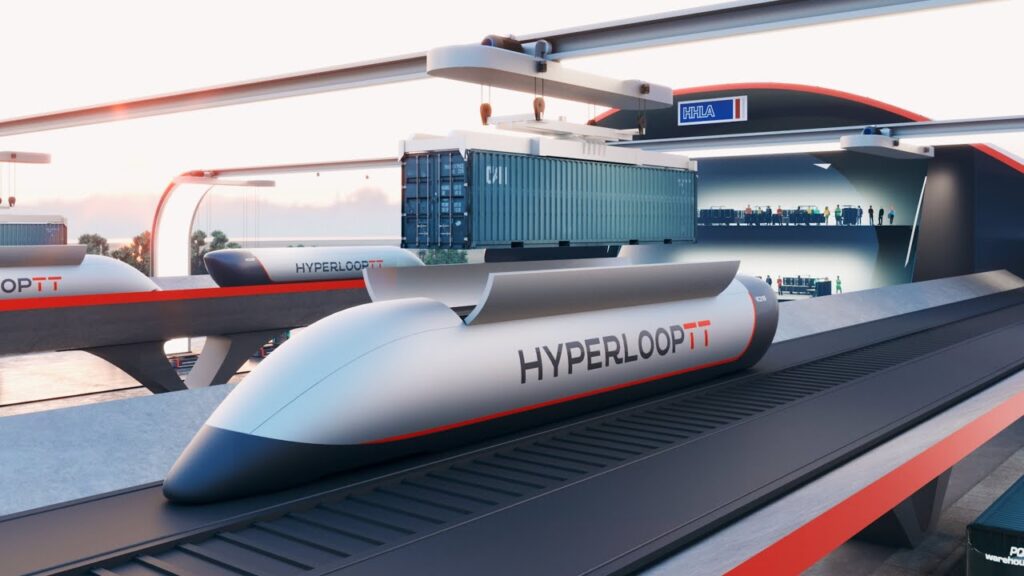
According to the study, Europe’s hyperloop companies have advanced significantly in recent years, moving from concept-level designs to building and operating test facilities. Several actors-located in the Netherlands, Spain, Germany, Poland, and France – are already conducting full-scale component and subsystem trials, with early integrated system testing expected within the decade.
The study highlights that hyperloop’s progress is no longer theoretical: infrastructure concepts, tube designs, pods, propulsion systems, and levitation technologies are being validated in controlled environments. The uploaded annex (pp. 5-7) identifies at least five active European test sites, marking Europe as one of the leading global regions in real-world experimentation.
Hyperloop’s potential aligns with several of the EU’s long-term objectives:
Commissioner Apostolos Tzitzikostas, responsible for Sustainable Transport and Tourism, stated:
“Today’s study shows that hyperloop technology could play a role in how Europe moves people and goods in the future. As we work towards a more connected and competitive Union, the EU will continue to support technologies like hyperloop that contribute to industrial innovation, regional cohesion and sustainability.”
The study also recognises the challenges that could slow hyperloop deployment:
The fact-finding study (pp. 10-12) notes that without early regulatory alignment, Member States may pursue divergent national approaches – creating future interoperability barriers.
The Commission already plays a role in promoting innovation and technical harmonisation. Through Europe’s Rail Joint Undertaking, the EU co-funds the Hyper4Rail project, which focuses on interoperability and common standards for hyperloop systems. The study also references (p. 14) a planned EU pilot project to develop safety requirements, ensuring technology-neutral and future-proof guidelines.
Looking ahead, the study recommends additional EU-level actions, including:
These findings will feed into the Commission’s upcoming strategy for promoting cutting-edge mobility technologies, as announced in Commissioner Tzitzikostas’ mission letter.
For freight transport and logistics, hyperloop introduces new possibilities for ultra-fast, zero-emission long-distance flows, particularly for high-value, time-sensitive goods. Its emphasis on automation, digitalisation and multimodal integration aligns with ALICE’s long-term vision for the Physical Internet, next-generation freight corridors and end-to-end efficiency.
ALICE will continue monitoring EU hyperloop developments, exploring opportunities for collaboration, standardisation and future deployment scenarios relevant to freight and logistics operators.
ALICE invites members and stakeholders working on hyperloop-related topics to contribute their perspectives and experience. Interested parties are encouraged to contact Giuseppe Luppino to join the discussion.
Read the full study by DG MOVE: New EU study assesses progress and prospects for hyperloop technology – Mobility and Transport