
Friday, December 26th, 2025
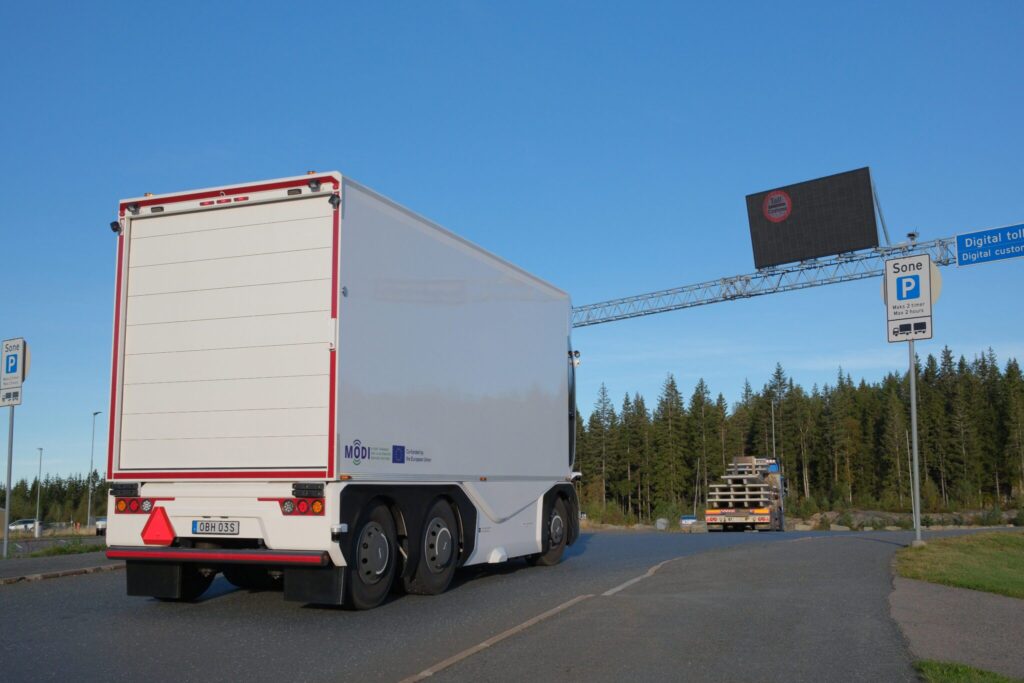
The EU-co-funded MODI project has reached a major milestone for automated logistics in Europe: the first-ever cabless, electric, fully autonomous cross-border operation without a human driver on board. Einride – one of MODI’s technology partners – successfully completed the world’s first autonomous border crossing at the Ørje customs station between Sweden and Norway, demonstrating a breakthrough moment for Connected, Cooperative and Automated Mobility (CCAM) in real operational conditions.
This achievement shows that autonomous logistics is no longer confined to controlled test tracks. It is moving into real-world, cross-border operations where regulatory, technical, and procedural obstacles are considerably more complex.
Hyper-automation of long-distance freight transport is one of Europe’s most complex innovation challenges. Cross-border automated driving is especially demanding due to:
Despite these obstacles, Einride’s system achieved a seamless autonomous crossing thanks to the tight technical integration between its cabless electric autonomous vehicle, its Autonomous Driving Stack (Einride Driver), and its cloud-based Control Tower, which supervises fleet operations in real time.
To remove the need for a human driver to handle customs procedures at the border, Einride connected its technology to Norway’s Digitoll system through MODI partner Q-Free. Goods were digitally pre-declared, enabling the autonomous vehicle to complete both a green lane and a red lane crossing, demonstrating compliance with Norwegian customs procedures.
This represents a first-of-its-kind demonstration of how digital customs, automation, and autonomous freight operations can be combined to significantly improve the efficiency, safety and sustainability of road transport.
The autonomous crossing builds on MODI’s mission: supporting the safe and practical deployment of heavy-duty CCAM in real-life logistics operations. MODI brings together leading public authorities, research institutions, and industry partners to test automated freight solutions across a variety of European use cases.
Henrik Green, CTO and General Manager for Einride Autonomous Technologies, commented:
“We are immensely proud to have completed the world’s first cableless, electric, fully autonomous cross-border delivery. The MODI project perfectly embodies our commitment to extending autonomous capabilities, balancing safety with innovation to deliver real value for transport and logistics.”
The demonstration also benefited from the strong collaboration between Swedish and Norwegian authorities and MODI partners including Statens Vegvesen, SINTEF, Q-Free, Trafikverket, and Indre Østfold kommune, and was carried out on behalf of PostNord, which manages nearly 200 million parcels annually across the Nordic region.
The MODI crossing is more than a technical demonstration – it is a strategic milestone that shows how Europe can:
ALICE continues to support the transition toward automated, connected and zero-emission freight by:
The MODI cross-border success demonstrates that Europe is moving decisively towards real-world CCAM operations that can transform logistics efficiency, safety and sustainability across long-distance corridors.
As the MODI project progresses, ALICE will continue sharing insights, lessons learned, and opportunities for broader deployment across Europe’s freight ecosystems.
Read the article: MODI achieves world-first cabless electric autonomous border crossing and customs passing – without a human driver onboard | MODI